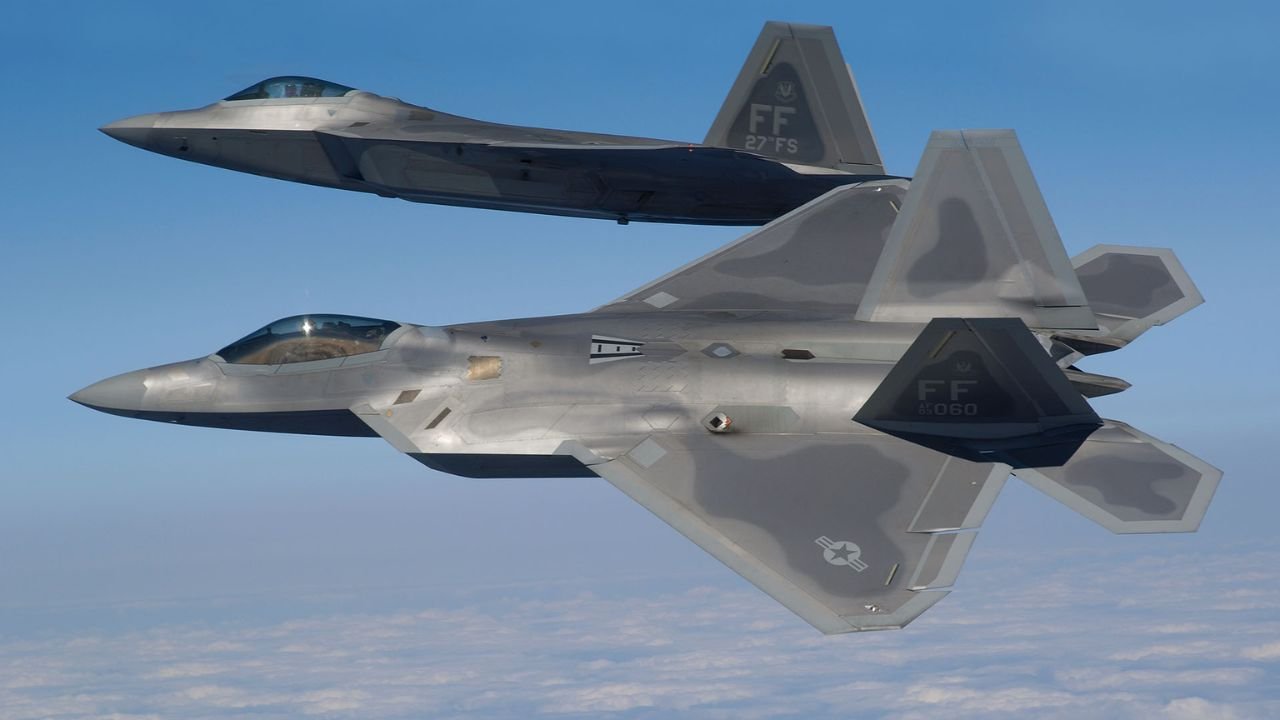
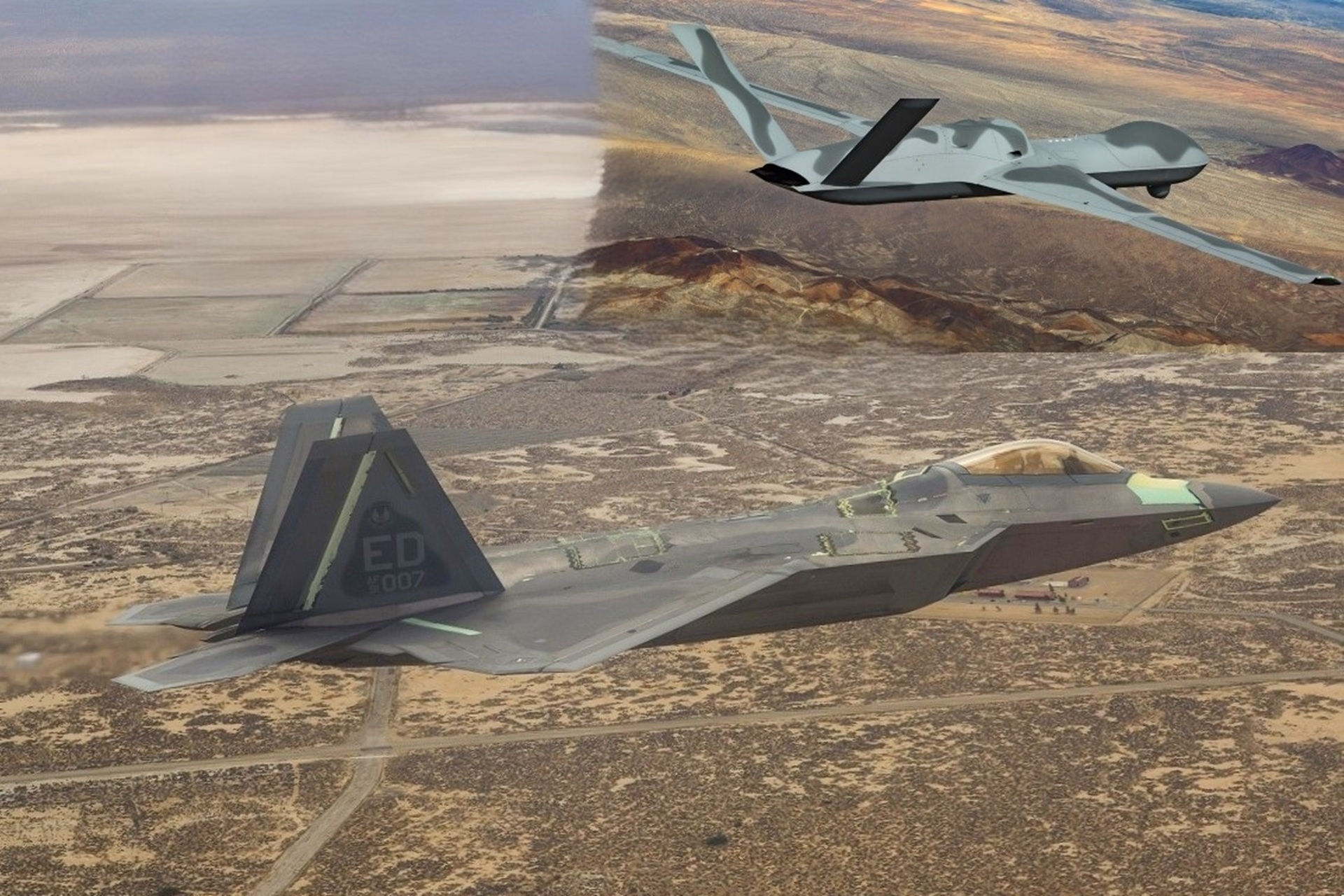
Recently, a test was carried out by the US defense company General Atomics and this has further elucidated the future directions of air warfare. In this examination, a manned F-22 Raptor and a pilotless MQ-20 Avenger that was propelled with a jet flew side by side. It was not a normal flight, but the experiment where man and artificial intelligence trained in war-like scenarios.
The experiment was conducted in Edwards Air Force Base where the pilot of the stealth fighter issued real-time commands to the drone. Drones that were under the pilot instructions carried out operations including tactical operations, combat air patrols and countering airborne threats. This drill showed that the wars of the future will not be waged by humans only, but rather in a collaboration of human beings and machines.
What is the concept of a ‘loyal wingman’?
The Collaborative Combat Aircraft Program (CCA) of the US Air Force is concerned with the development of drone that will serve as the loyal wingman of a pilot. This implies that such drones will pilot together with the main fighter jet, obey its commands, and even make their own decisions in case of necessity.
Such drones are not viewed as fully disposable, although they are cheaper and risk-adverse compared to the costly fighter jets. As an illustration, the drones operated by CCA will be cheaper than the current-day fighters such as the F-35 Lightning II, which implies that they will be used initially during risky missions.
From Tablet to Command: A Major Technological Step
In an earlier test conducted in November 2025, an F-22 pilot controlled an MQ-20 via a tablet. However, the latest test went a step further. This time, the F-22 used government autonomous software, which instantly transmitted commands to the drone via a tactical data link.
The unique feature of this technology was that the drone, using its onboard sensors, assessed the situation and made independent decisions. This means that the pilot was simply giving orders, but the drone’s own intelligence was also involved in the decision-making. This is a true glimpse of the future of warfare—where machines will not only obey orders, but will also be able to think and react.
Next-Generation Fighters and Drones
The US Air Force plans to deploy such drones alongside the future sixth-generation fighter, the F-47. Under the CCA program, various companies are developing their own models, including the YFQ-42, YFQ-44, and YFQ-48A.
All of these systems are designed to be easily upgradeable and compatible with advanced manned aircraft. These drones can also perform a variety of tasks, including air-to-air combat, strike missions, and intelligence gathering, all on their own.
Not a Replacement for Humans, But a Strong Partnership
US Air Force has clarified that CCA drones do not mean that human pilots will be eliminated. They are used to supplement, and not to substitute, human forces. These drones will serve as a force multiplier, because they will introduce more sensors, weapons and surveillance in the battlefield.
Pilots might not be isolated in the cockpit in the future as intelligent drones will fly through the skies and assist the pilots throughout the battle. This alliance will remodel air power in the future.
FAQs
1. What was tested in the recent flight demonstration?
General Atomics tested autonomous coordination between an F-22 Raptor and the MQ-20 Avenger drone.
2. What is a Collaborative Combat Aircraft (CCA)?
A CCA is an advanced drone designed to fly alongside manned fighter jets as a “loyal wingman” or operate autonomously during missions.
3. How did the F-22 pilot control the drone?
The pilot used onboard autonomy software and a tactical data link to send real-time commands to the MQ-20.
4. Are CCA drones meant to replace human pilots?
No, they are designed to support and enhance human pilots, not replace them.
5. Why are CCAs important for the Air Force?
They act as force multipliers by adding sensors, weapons, and mission capabilities at a lower cost and reduced risk compared to manned fighter jets.