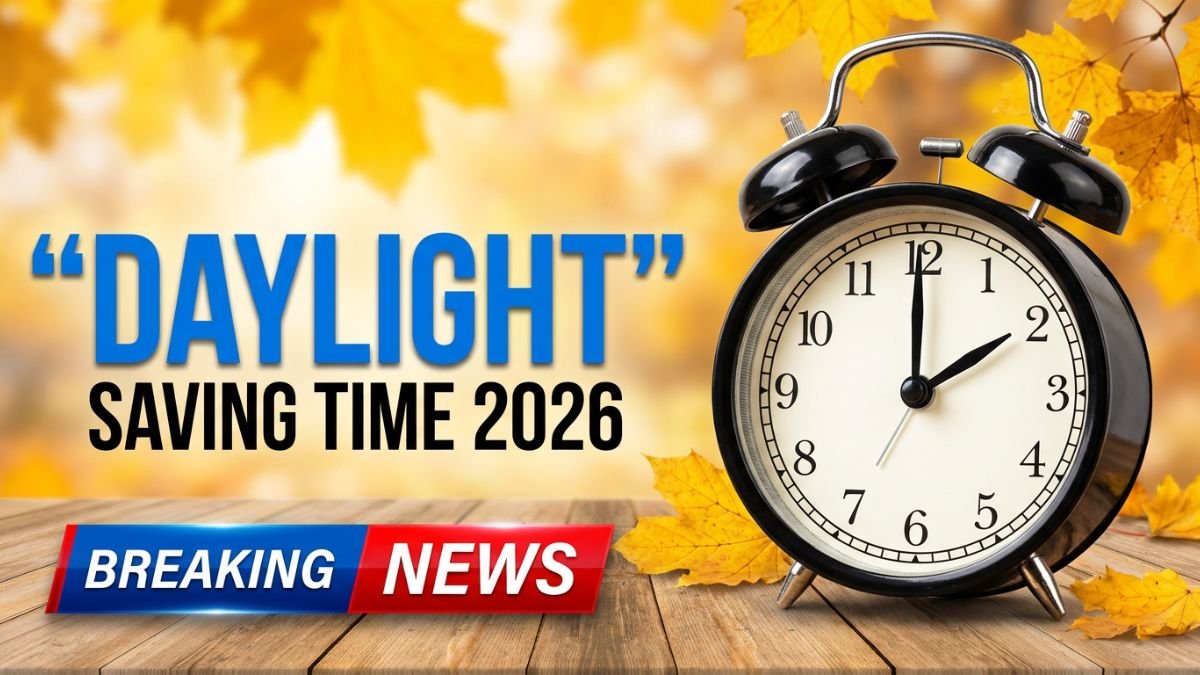
Every year, with the onset of spring, a day arrives in the United States when millions of people, without warning, lose an hour of sleep. In 2026, this day will be March 8th. At exactly 2:00 a.m. that night, clocks will jump to 3:00 a.m. This means a full hour of sleep will be “snapped.” This is the moment when Daylight Saving Time (DST) begins.
Most people will wake up that Sunday morning feeling a little tired, sleepy, and a little unsettled. Although they will gain an extra hour of daylight in the evening, it will come at the cost of morning sleep. In 2026, this change is occurring at the earliest possible date on the calendar, making it even more of a topic of discussion.
Why is this date so early?
Daylight Saving Time begins on the second Sunday in March. This rule was established under the Energy Policy Act of 2005. In 2026, the second Sunday of March falls on the 8th, the earliest possible legal date. This is why the time change feels relatively “early” this time.
This arrangement will continue until November 1, 2026. On that day, clocks will be set back one hour again, and standard time will return. This means that this tradition of changing time twice a year will continue in 2026.

What was the original idea behind Daylight Saving Time?
The idea of Daylight Saving Time was introduced to save energy. It was believed that if there was more natural light in the evenings, people would use less electricity. This concept gained popularity during the 20th century, and many countries adopted it.
Over time, however, questions arose about whether this system actually saves energy in modern times, with air conditioners, electronic devices, and a 24-hour economy. Some studies have shown modest benefits, while others have found them to be almost negligible. This is why the debate continues.
Health Impact
Losing even one hour of sleep may sound trivial, but it’s a significant shock to the body’s biological clock. Our bodies have a natural rhythm called the circadian rhythm. When the time changes suddenly, this rhythm becomes unbalanced.
Several studies have found that fatigue, irritability, decreased concentration, and decreased performance are observed for a few days after the springtime advance. Some reports have also noted a slight increase in heart attacks, strokes, and road accidents. Experts believe this may be the result of sleep deprivation and biological clock imbalance.
The impact is particularly pronounced on children and the elderly. Children have difficulty waking up early in the morning, while for the elderly, the change in sleep rhythm can put additional strain on their health.
Political Debate: Will the Time Change Stop?
Calls to end Daylight Saving Time are not new. This issue has been debated in the US Congress for years. A proposal called the “Sunshine Protection Act” has been introduced several times, aiming to permanently keep the country on daylight saving time.
But the problem is that not everyone agrees. Some leaders favor permanent daylight saving time, allowing for more daylight in the evenings year-round. Others believe permanent standard time is preferable because it allows for early morning natural light, which is considered more conducive to health.
These differences are preventing this issue from moving forward. As a result, bills remain stuck in committees, and ordinary citizens are forced to change their clocks twice a year.
Permanent Daylight Saving Time vs. Permanent Standard Time
If the time change is to be abolished, the question is, which time should be adopted permanently?
Permanent Daylight Saving Time would mean that sunrise would be delayed even in winter. This would cause darkness to persist longer in the morning. Children would wait for the school bus in the dark, and working people would travel before sunrise.
On the other hand, permanent Standard Time would ensure early morning light, which is in line with the body’s biological clock. Many health experts believe that standard time is more natural for the human body.
Which states do not observe the time change?
Not all U.S. states observe Daylight Saving Time. Arizona and Hawaii remain on standard time year-round. Territories such as Puerto Rico, Guam, the U.S. Virgin Islands, American Samoa, and the Northern Mariana Islands also do not observe the time change.
There is also an interesting situation within Arizona. The Navajo Nation observes Daylight Saving Time, while the surrounding Hopi Reservation does not. This is a complex administrative situation, but it demonstrates how complex the time change issue is.
Social and Economic Impacts
The time change isn’t limited to sleep or health. It also impacts the economy and social life. Additional evening light can be beneficial for retail stores, sports activities, and the entertainment industry.
However, morning darkness can impact productivity. Concentration and energy levels may decrease early in the workplace. Some studies have even indicated an increase in workplace accidents.

Public Opinion
Most people are troubled by the twice-a-year time change. Surveys often find that people want to end this change. But they are divided on which time should be permanent.
Some people prefer evening light because it allows them to spend time with family and friends. Others consider morning natural light more important.
What’s Next?
Currently, in 2026, clocks will move forward on March 8th and back on November 1st. Unless a clear decision is made at the federal level, this cycle will continue.
The debate over Daylight Saving Time will likely intensify in the coming years. Arguments related to health, the economy, and lifestyle complicate this discussion. But until then, one morning in March, we will again wake up a little sleepy—and set the clocks forward an hour.
Conclusion
“Daylight Saving Time 2026 Is Coming and It’s Earlier Than You’d Expect” is not just a calendar event but part of a tradition that has continued for decades and is still mired in controversy. On one hand, there are arguments for energy savings and evening light; on the other, concerns about health and biological balance.
One hour of sleep may seem like a small price, but its effects can be widespread. Until a permanent solution is found, this annual change will remind us that time resides not only in the clock but also in our bodies and lifestyles.
FAQs
Q. When does Daylight Saving Time start in 2026?
A. Daylight Saving Time begins on March 8, 2026, at 2:00 a.m., when clocks move forward to 3:00 a.m.
Q. When does Daylight Saving Time end in 2026?
A. It ends on November 1, 2026, when clocks move back one hour to standard time.
Q. Why do we lose an hour in March?
A. Clocks are set forward to extend evening daylight during the warmer months.
Q. Does every U.S. state observe Daylight Saving Time?
A. No. States like Arizona and Hawaii do not observe Daylight Saving Time.
Q. Is there a plan to make Daylight Saving Time permanent?
A. There have been proposals in Congress, but no permanent change has been approved yet.