
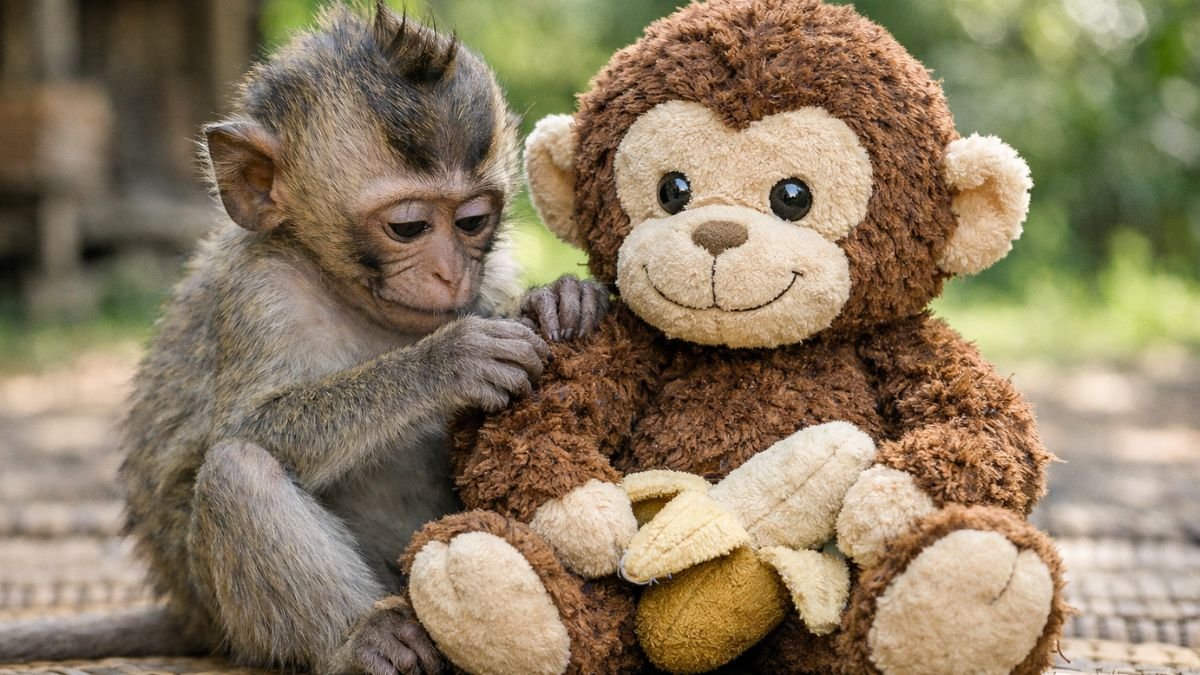
In a quiet corner of a wildlife rescue center, a small macaque named Punch has captured hearts far beyond the place he now calls home. His story is not one of spectacle or drama, but of tenderness, healing, and the deep emotional world animals inhabit. Orphaned at a very young age, Punch lost the one relationship every infant depends on for survival and comfort. What followed was a journey marked by fear, confusion, and eventually, hope. Today, one of the most touching sights in the sanctuary is Punch carefully grooming a soft stuffed animal while sitting beside his new best friend, a moment that speaks volumes without a single word.
A Difficult Beginning for a Young Life
Punch’s early days were shaped by loss. In the wild, macaque infants rely entirely on their mothers for warmth, protection, food, and social learning. When Punch became orphaned, that foundation vanished overnight. He arrived at the rescue center fragile, frightened, and emotionally withdrawn. Like many orphaned primates, he showed signs of stress that went beyond physical weakness. His eyes constantly searched for reassurance, and his small body clung to anything that offered even a hint of comfort.
Caretakers knew immediately that Punch’s needs would not be met by food and medical care alone. Emotional rehabilitation would be just as important as physical recovery. Without the soothing presence of a mother or troop, Punch needed something to replace the sense of safety he had lost.
The Role of Comfort Objects in Animal Healing
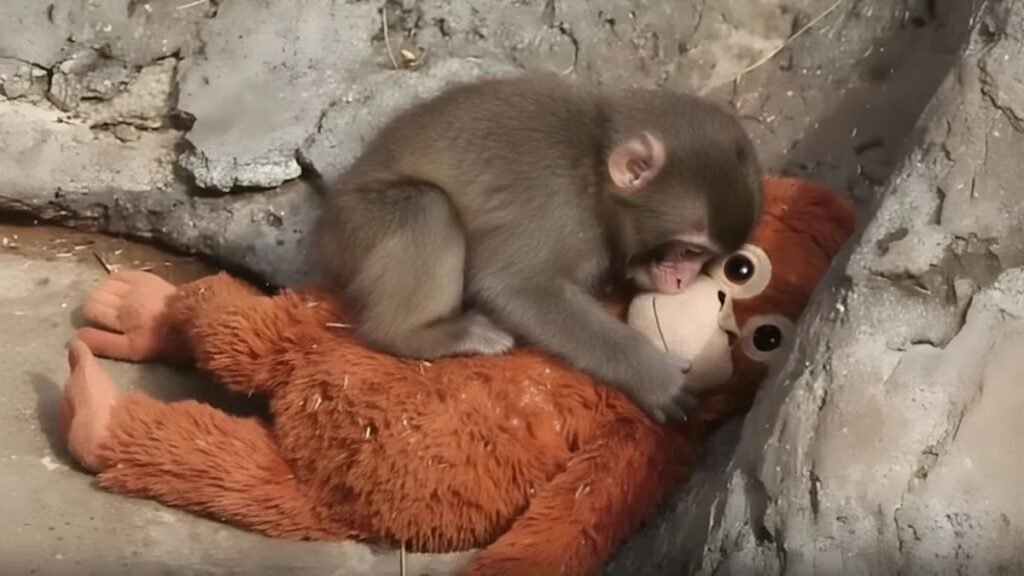
It was during this delicate phase that caregivers introduced a stuffed animal into Punch’s enclosure. To human eyes, it might have seemed like a simple toy, but for Punch, it became something much more meaningful. He wrapped his arms around it, pressed his face into its soft surface, and carried it wherever he went. Over time, he began grooming it, gently picking through the fabric as macaques do with each other in moments of bonding and calm.
Grooming is not just a hygienic behavior for macaques; it is a language of trust, affection, and emotional regulation. By grooming the stuffed animal, Punch was expressing instincts deeply rooted in his species. It was his way of coping with loneliness, recreating a bond he had lost too soon.
Learning to Trust Again
At first, Punch remained wary of others, including the humans who cared for him. Sudden movements startled him, unfamiliar sounds made him freeze, and new environments caused visible anxiety. The stuffed animal became his anchor. Whenever he felt overwhelmed, he returned to it, grooming it slowly as if reassuring himself that he was not alone.
Over weeks and months, caretakers noticed subtle changes. Punch began to explore his surroundings more confidently. He ate better, played briefly on his own, and even showed curiosity toward other young macaques nearby. The presence of the comfort object seemed to give him the emotional stability he needed to begin opening up to the world again.
The Arrival of a New Companion
One day, Punch’s routine changed in a quiet but significant way. Another young macaque, also rescued and in need of socialization, was introduced into a nearby space. Caretakers carefully monitored their interactions, knowing how sensitive such introductions can be for orphaned primates. At first, Punch kept his distance, clutching his stuffed animal close.
But curiosity slowly overcame caution. He watched the newcomer closely, observing movements, sounds, and behavior. The other macaque, gentle and equally tentative, showed no signs of aggression. Instead, there was a shared stillness between them, a mutual understanding born from similar experiences of loss and transition.
The First Signs of Friendship
The moment that would later melt hearts came unexpectedly. One afternoon, Punch sat beside his new companion with his stuffed animal resting between them. Instead of pulling away, the other macaque leaned closer. Punch began grooming his stuffed animal as usual, but this time, his new friend stayed, watching intently.
Soon, the two sat side by side in comfortable silence. Punch continued his careful grooming motions, occasionally glancing at his companion, who responded with calm curiosity. It was not loud or dramatic, but it was profound. This was the beginning of trust, the first thread of a new bond being quietly woven.
Grooming as a Shared Emotional Space
In macaque societies, grooming is one of the most important social behaviors. It strengthens bonds, reduces stress, and reinforces group harmony. For Punch, grooming his stuffed animal had been a solitary act of self-soothing. Now, it became something shared.
As days passed, his new friend grew more comfortable sitting close during these moments. Sometimes, the companion would gently touch the stuffed animal or sit close enough that their shoulders brushed. Punch did not pull away. Instead, his grooming became slower, more relaxed, as if the presence of another living being added a new layer of comfort.
What This Behavior Tells Us About Animal Emotions
Scenes like this challenge outdated ideas about animals being driven purely by instinct. Punch’s actions reveal emotional complexity that mirrors, in many ways, human coping mechanisms. The stuffed animal serves as a transitional object, much like a blanket or toy for a human child, while the shared grooming reflects a readiness to form new relationships.
The fact that Punch feels safe enough to groom in the presence of another macaque shows emotional growth. It indicates trust, reduced anxiety, and an emerging social confidence. These small moments are powerful markers of healing in rescued animals.
The Caregivers’ Perspective
For the caregivers who have walked alongside Punch since his arrival, these moments are deeply rewarding. Rehabilitation is often slow and filled with setbacks. There are days when progress feels invisible. Watching Punch groom his stuffed animal beside a new friend is a reminder of why patience matters.
Caretakers emphasize that such scenes are not encouraged for entertainment, but observed as signs of genuine emotional development. The goal is always to help animals like Punch regain as much natural behavior and social connection as possible, preparing them for a future where they can live with others of their kind.
Building Toward a Social Future
While the stuffed animal has played an important role in Punch’s recovery, caregivers know it may not always be necessary. As Punch forms stronger bonds with other macaques, his reliance on the comfort object may naturally fade. This is a healthy progression, showing that his emotional needs are being met through real social interaction.
For now, there is no rush. Healing follows its own timeline, especially after early trauma. The priority is ensuring that Punch feels secure, supported, and free to express himself in ways that feel natural to him.
Why Punch’s Story Resonates With People
Stories like Punch’s resonate deeply because they reflect universal themes of loss, resilience, and connection. Many people see echoes of their own experiences in his journey. The image of a small orphaned macaque grooming a stuffed animal beside a new friend speaks to the power of companionship and the importance of patience in healing.
It also highlights the often-overlooked emotional lives of animals, encouraging greater empathy and understanding. When people witness such moments, it becomes harder to dismiss animals as unfeeling or replaceable.
A Quiet Symbol of Hope
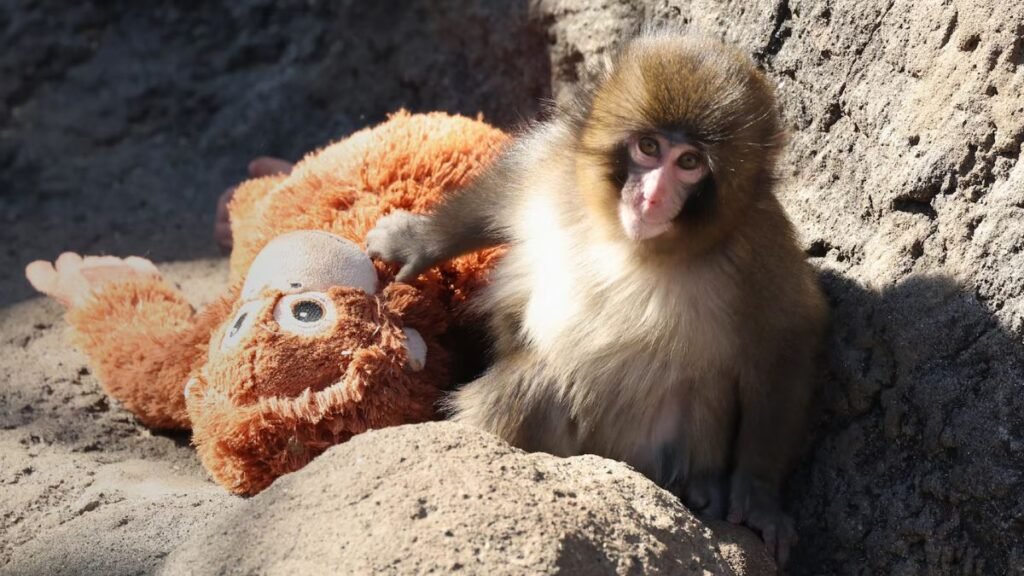
Punch’s story is not about instant recovery or dramatic transformation. It is about small, meaningful steps forward. Each grooming session, each shared moment of calm, represents progress. The stuffed animal, once a symbol of loss, has become part of a bridge leading Punch back to connection.
Sitting beside his new best friend, Punch no longer feels entirely alone. His world, once defined by absence, is slowly filling with presence, trust, and warmth.
Conclusion: Healing Through Connection
Punch the orphaned macaque grooming his stuffed animal with his new best friend is more than a heartwarming image. It is a testament to the resilience of living beings and the profound role of connection in healing. Through patience, compassion, and understanding, Punch has begun to rebuild what was taken from him too early.
As he continues his journey, each gentle grooming motion reminds us that healing does not always roar. Sometimes, it arrives quietly, in the shared stillness between two souls learning how to trust again.
FAQs
Q1. Why does Punch groom a stuffed animal?
Grooming helps Punch feel safe and calm, replacing the comfort he lost after being orphaned.
Q2. What does this behavior show about macaques?
It shows that macaques have deep emotional needs and use bonding behaviors to cope and heal.
Q3. Will Punch always need the stuffed animal?
As he forms stronger bonds with other macaques, he may naturally rely on it less over time.

