
US Inflation Update Today 2026: Prices Just Shocked America — The beginning of 2026 brought some relief for investors and the general public. According to the January inflation report, the Consumer Price Index (CPI) fell to 2.4%, the lowest level since May of last year and lower than most economists had predicted. This decline led to a decline in bond yields, raising market expectations of a possible interest rate cut in the near future. Interestingly, some alternative data indicates that inflation may fall even further in the next six months. This is why ordinary people are still worried about grocery bills, while large investors are busy formulating future strategies.
What was the real reason for the decline?

The biggest driver of the decline in inflation in January was a decrease in energy prices. Petrol prices fell by approximately 3.2% in a month, bringing overall inflation down. Core inflation, excluding food and energy, was 0.3% monthly and 2.5% annually, the lowest since March 2021. Housing costs—which account for approximately 35% of the CPI—rose only 0.2%. This figure appears normal, but it holds the most important key to understanding the direction of inflation.

Housing Data Delays: Government Data Lags Behind Reality
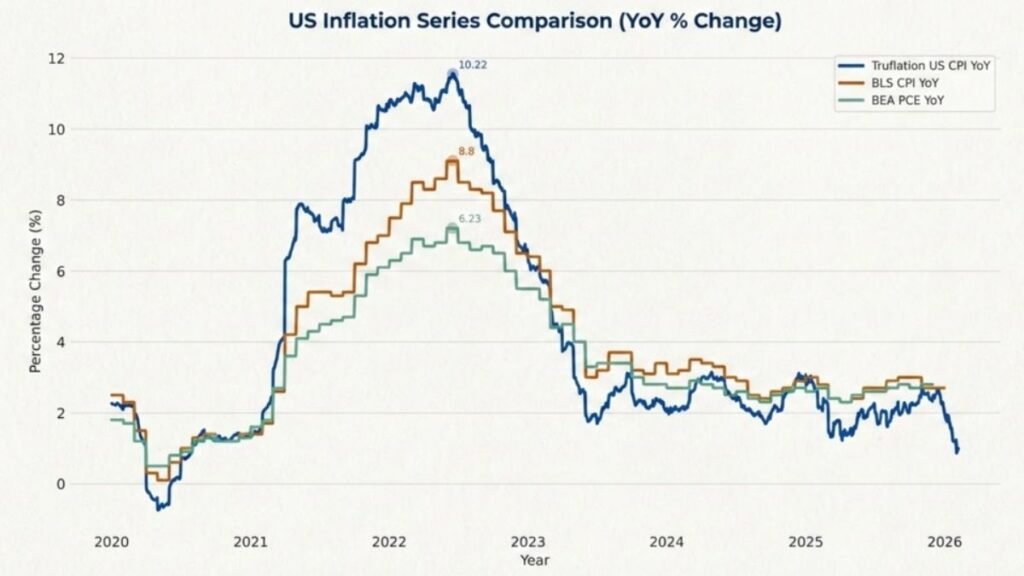
The U.S. Bureau of Labor Statistics measures housing costs based on rent and “Owner Equivalent Rent.” According to the National Bureau of Economic Research, this methodology inherently has a lag because most rents are based on 12-month contracts. This means that even if rents decline in the market, their impact is reflected in government data late. According to data from the real-time property platform Zillow, rents have already begun to decline, but their impact may take several quarters to be reflected in the CPI.
What is the real-time data telling us?
Truflation, a company used by institutional investors, releases daily inflation estimates. As of February 21st, its figure was only 0.97%—significantly lower than the official estimate of 2.4%. The company says that consumers are no longer willing to accept rising prices, which has reduced companies’ power to raise prices. This change isn’t immediately visible in traditional surveys, but is clearly visible in actual purchase and sale data.

Why could inflation further decline?
Three additional reasons are emerging. First, used car prices are falling due to improved supply chains. Second, employment growth is slowing, which is slowing wage growth and reducing pressure on service prices. Third, the “base effect”—that is, annual inflation will appear lower this year, replacing last year’s high figures.
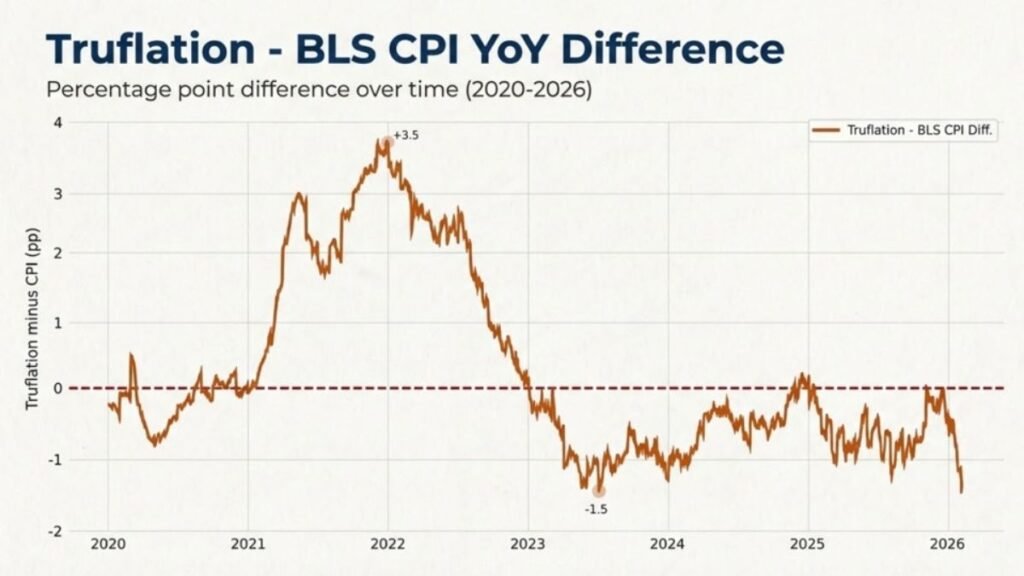
Risks Remain
However, a decline is not certain. The Peterson Institute for International Economics warns that trade tariffs and labor shortages could push inflation higher again. On the other hand, the Federal Reserve kept interest rates steady at 3.5%–3.75% in January, but under Chairman Jerome Powell’s leadership, a rate cut is possible by mid-2026 if inflation continues to fall.
What does this mean for ordinary consumers and investors?
The good news for ordinary consumers is that price increases are slowing, although prices haven’t yet leveled off. Some items—like used cars and electronics—are becoming cheaper, but healthcare and electricity remain expensive. The signal for investors is clear: if housing inflation truly declines, interest rate cuts could accelerate and change the market’s direction.
Conclusion
Both government statistics and real-time data point to a decline in inflation. The real question isn’t whether inflation will decline—but when this reality will be fully reflected in government data.
FAQs
Q. What is the current U.S. inflation rate?
A. The January 2026 CPI inflation rate is about 2.4%, the lowest since May last year.
Q. Why did inflation fall in January?
A. Mainly due to lower energy prices, especially a drop in gasoline costs.
Q. What is core inflation?
A. Core inflation excludes food and energy prices; it was about 2.5% annually.